Tuesday, 2 February 2021

Ball lightning


The Bizarre Phenomenon of 'Ball Lightning' Has a Startling New Explanation

As far as mysteries of nature go, ball lightning is one of the more perplexing. It seems there are as many potential explanations as there are sightings, but in spite of decades of intense interest, none stand out as a clear winner. 


One of the weirder hypotheses claims these glowing balls are nothing more than light trapped inside a sphere of thin air. A new paper has added fresh details to the proposal, setting physical parameters on what such a light bubble might be like.

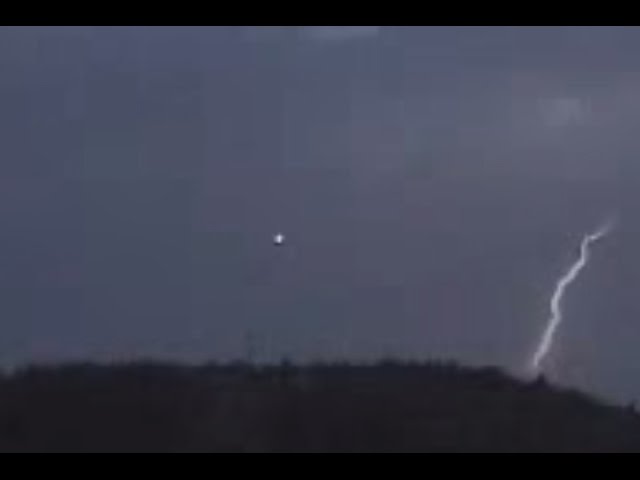
For centuries, people have recorded accounts of grape-fruit-sized orbs of light moving slowly a short distance above the ground, often in the middle of an electrical storm, persisting for maybe 10 seconds or so before silently winking out of existence.

Occasionally there is an added effect or two. Some have been said to pass through the glass pane of a closed window. Others might go out with a bang, or even leave behind the stench of sulphur as they vanish.

Over a decade ago, Vladimir Torchigin from the Russian Academy of Sciences came to the conclusion that the atmospheric phenomenon we call ball lightning isn't lightning at all, but rather photons ricocheting inside an air-bubble of their own making.  

Whatever ball lightning happens to be, though, history isn't short on eyewitness reports.

Pulling apart myth from facts isn't easy, however, and in the past they were treated with a generous dose of scepticism. Today, researchers are cautiously optimistic that there's probably something to the multitude of observations.


In the 1970s, ball lightning researcher Stanley Singer suggested there were three essential features any successful model explaining the phenomenon had to account for; the duration of ball lightning, its floating motion, and its sudden disappearance.

Just a few years ago, an alleged event of ball lightning in China was by chance captured on a spectrograph following a lightning bolt striking the ground, providing researchers with a breakdown of its electromagnetic spectrum.

The research backs up an explanation by University of Canterbury engineer John Abrahamson, who suggested the glowing air could be the result of vaporised ground material being pushed up by a shockwave of air.

Other suggestions imagine clouds of charge-repulsing ions collecting on an insulator such as a glass sheet, providing a basis for the long life spans as well as drifting and 'bouncing' movements.

Torchigin's idea is as simple as it is highly speculative. It has nothing to do with charged ions, and everything to do with the intense shower of photons shed by a bright flash inside our atmosphere.

As any particle absorbs and emits electromagnetic radiation, there is a recoil referred to as the Abraham-Lorentz force. In theory, light spilling from a lightning strike causes air particles to jiggle as they absorb and transmit electromagnetic radiation.


This force isn't all that impressive under most circumstances, as even Torchigin admits by stating, "[t]hese forces are extremely small for conventional intensities of light, and their action is rightly ignored".

But the extreme intensity of a lightning strike isn't your normal flash. What's more, these optical forces could potentially be magnified considerably under the right conditions.

Those 'right conditions', according to Torchigin, involve the generation of a thin layer of air that refracts the light back in on itself.

A thin layer of air – not unlike the film of a bubble – could effectively focus light like a lens, intensifying the light enough to shove air particles into a boundary and produce a long-lived bubble, concentrating photons for seconds at a time.

Not all ball lightning 'embryos' would be successful, fading immediately for want of light or a sufficiently closed shell. But those that did hang around would look spectacular as they bobbed a haunting path through virtually any transparent medium.

The idea has been kicked around by Vladimir and his Russian Academy of Sciences colleague Alexander Torchigin in dozens of papers over the years.

Vladimir's most recent discussion on the topic combines numerous assumptions with physical models to pin down the light density and air pressure required to produce a suitable refraction index.

This might not explain some of the more violent endings to ball lightning, or the spectroscopic observations like those captured in China, or even necessarily the sulphurous smells.

But it does provide some numbers that could lead to necessary experiments that either rule out the hypothesis or give it an empirical backbone.

It's entirely possible Torchigin's idea is itself a lot of hot air, of course. But until we have a consensus on what might be behind those spooky, glowing spheres, it'll remain one of the more interesting contenders for a ball lightning theory.

This research was published in Optik.


Ball lightning exists ... but what on Earth is it?


Ball lightning is one of the strangest phenomena on our planet. It’s usually seen during thunderstorms as a ball of light about the size of a grapefruit, with the intensity of roughly a 40W light bulb. It moves at about walking speed, roughly a metre above the ground, and lasts about ten seconds.

It’s been seen by hundreds of people for hundreds of years in almost every country of the world – but has remained something of a mystery. Put simply, we don’t know what it is, what provides its energy, or why it moves independently of any breeze.

But my colleagues and I have published a new paper that should shed some light on this mysterious phenomenon and bring us one step closer to understanding, definitively, what ball lightning is.

A bright history

My association with ball lightning began in the 1960s when I was working for Westinghouse Research Laboratories in Pittsburgh in the USA – working on the theory of cooling air formed from electric arcs in circuit breakers.

Next to my office was the office of physicist Martin Uman who now, having written three text books on lightning, is regarded as the world’s leading lightning scientist.

One day, over coffee, Martin mentioned that ball lightning was one of the very few phenomena we don’t understand at all, despite having been seen by hundreds, maybe thousands of people.

I replied that I thought ball lightning was just hot air produced from a lightning strike – the ball of hot air being so large that it cooled only slowly, giving it a lifetime of seconds (rather than the fraction of a second a lightning strike lasts for).

Several months later, Martin came back from one of his trips to Washington with a contract from the US Air Force for me to research ball lightning. I presume the US Air Force were interested to be able to make ball lightning and use it in the Vietnam War to scare the Viet Cong!
But there was a problem with my “hot air” theory: hot air rises and ball lightning does not generally rise. In 1969, after the contract period had expired, my colleagues and I concluded we still had no idea what ball lightning was.

Yet we wrote a paper, published in the Journal of Geophysical Research, entitled Toward a theory of Ball Lightning, in which we explained ball lightning could not just be hot air because hot air rises.

Lighting up the house

While many sightings of ball lightning have been made outdoors, it is also seen inside houses. In fact a recent French survey of 350 sightings in France found far more observations of ball lightning inside houses than outside (181 to 94).

Perhaps even scarier, ball lightning has been seen inside of aeroplanes.

Luckily, it seems the ball lightning that appears inside of houses and aeroplanes is harmless and no injuries have been reported. I’ve heard one report of ball lightning in a plane passing right through or around an air hostess as it travelled down the central aisle of the plane.

(By contrast, outdoor ball lightning has been seen to initiate very damaging lightning strikes.)

So how do these balls of lightning get inside houses and aeroplanes? And why does ball lightning almost always move?
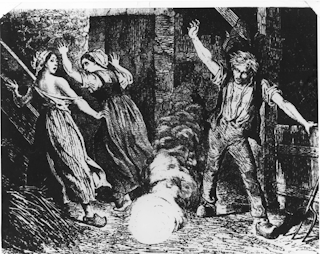
Nineteenth century depiction of

People claim to have seen ball lightning entering a house through a closed glass window, yet subsequent examination of the window reveals no damage or even discolouration of the glass.

There have been hundreds of papers written in scientific journals speculating on these issues, variously assigning the energy source of ball lightning to nuclear energy, anti-matter, black holes, masers, microwaves … you name it.

A recent theory (besides our own) about ball lightning – published in Nature in 2000 by John Abrahamson at the University of Canterbury, New Zealand – is that ball lightning is a ball of burning dendrites (branched projections) of silicon fluff formed after a lightning strike vaporises material from the ground.

But it seems impossible that such a mechanism could cause ball lightning inside a house or aeroplane.

New and improved

The new theory about ball lightning that my colleagues and I have published is unlike any before it.

We propose ball lightning is powered by ions (charged particles) formed in the atmosphere, particularly from lightning, where columns of ions kilometres in length are produced from a lightning strike and “stepped leaders” (paths of ionised air).

In this way, ball lightning does not “pass through” closed glass windows, but is formed on the inside surface of the window by ions piling up at the outside surface of the window.

The piled up ions on the outside surface of the glass – which is an electrical insulator – increase the electric field on the inside of the glass, and can initiate ionisation – that is, the creation of charged particles.

Charges of the opposite sign to those outside on the window will be attracted to the inside of the window leaving a charged sphere of plasma free to move away from the window. This discharge is ball lightning.

Using the conventional equations for electron and ion motion in an electric field we were able to predict such a ball-like structure from a stream of ions impacting on glass.

In this way, we’ve explained (we believe) the principal mysteries of ball lightning. The energy source is ions left in the atmosphere after a lightning strike. The roughly ten-second lifetime of ball lightning can be explained as the time taken for ions to be dispersed to the ground.

The ball moves due to electrical forces from other ions that have collected on insulators, such as those that exist on the walls of rooms or aircraft. For instance, ions from the ball lightning discharge can collect on a plastic or wooden surface if the ball comes into contact with it, repelling the ball and giving the appearance of “bouncing”.

Creating ball lightning

Of course, the definitive proof of any theory is experiment. What we need is an experiment to actually reproduce ball lightning in a controlled way.

Several of the observations in aircraft have been when there was no evident thunderstorm. We postulate that the ions in this case were produced by the aircraft’s radio antenna.

If this is true, such experiments for the production of ball lightning should be possible, independent of the power sources of natural lightning, which typically generates up to 100 million volts.

If these experiments come to fruition, it is highly likely that, in the next few years, the long-standing mystery of ball lightning will be definitively solved.

Wednesday, 20 January 2021

Panspermia and the origin of life on earth


panspermia theory lithopanspermia origin of life Earth exogenesis directed panspermia meteorite asteroid cometPanspermia is a Greek word that translates literally as "seeds everywhere". The panspermia hypothesis states that the "seeds" of life exist all over the Universe and can be propagated through space from one location to another. Some believe that life on Earth may have originated through these "seeds".

Mechanisms for panspermia include the deflection of interstellar dust by solar radiation pressure and extremophile microorganisms traveling through space within an asteroid, meteorite or comet.

Three popular variations of the panspermia hypothesis are:

  • Lithopanspermia (interstellar panspermia) - impact-expelled rocks from a planet's surface serve as transfer vehicles for spreading biological material from one solar system to another.
  • Ballistic panspermia (interplanetary panspermia) - impact-expelled rocks from a planet's surface serve as transfer vehicles for spreading biological material from one planet to another within the same solar system
  • Directed panspermia - the intentional spreading of the seeds of life to other planets by an advanced extraterrestrial civilization, or the intentional spreading of the seeds of life from Earth to other planets by humans

Panspermia does not provide an explanation for evolution or attempt pinpoint the origin of life in the Universe, but it does attempt to solve the mysteries of the origin of life on Earth and the transfer of life throughout the Universe.


The first known mention of the concept of panspermia was in the writings of the Greek philosopher Anaxagoras (500 BC – 428 BC), although his concept differs from the modern theory:

All things have existed from the beginning. But originally they existed in infinitesimally small fragments of themselves, endless in number and inextricably combined. All things existed in this mass, but in a confused and indistinguishable form. There were the seeds (spermata) or miniatures of wheat and flesh and gold in the primitive mixture; but these parts, of like nature with their wholes, had to be eliminated from the complex mass before they could receive a definite name and character.

In 1743 the theory of panspermia appeared in the writings of French nobleman, diplomat and natural historian Benoît de Maillet, who believed that that life on Earth was "seeded" by germs from space falling into the oceans, rather than life arising through abiogenesis.

The panspermia theory was rekindled in the nineteenth century by the scientists Jöns Jacob Berzelius (1779–1848), Lord Kelvin (William Thomson) (1824–1907) and Hermann von Helmholtz (1821–1894). Lord Kelvin declared in 1871, "[W]e must regard it as probable in the highest degree that there are countless seed-bearing meteoric stones moving about through space. If at the present instance no life existed upon this Earth, one such stone falling upon it might, by what we blindly call natural causes, lead to its becoming covered with vegetation."

In 1973 the late Nobel prize winning British molecular biologist, physicist and neuroscientist Professor Francis Crick, along with British chemist Leslie Orgel, proposed the theory of directed panspermia.


panspermia microbes Mars meteorite ALH84001 Antarctica lithopanspermia directed panspermiaA meteorite blasted off from the surface Mars about 15 million years ago was found in Antarctica in 1984 by a team of scientists on an annual United States government mission to search for meteors. The meteor was named Allan Hills 84001 (ALH84001). In 1996 ALH84001 was shown to contain structures that may be the remains of terrestrial nanobacteria. The announcement, published in the journal Science by David McKay of NASA, made headlines worldwide and prompted United States President Bill Clinton to make a formal televised announcement marking the event and expressing his commitment to the aggressive plan in place at the time for robotic exploration of Mars. Several tests for organic material have been performed on ALH84001 and amino acids and polycyclic aromatic hydrocarbons (PAH) have been found. However, most experts now agree that these are not a definite indication of life, but may have instead been formed abiotically from organic molecules or are due to contamination from contact with Antarctic ice. The debate is still ongoing, but recent advances in nanobe research has made the find interesting again.

The announcement of the discovery of evidence of life on ALH84001 sparked a surge in support for the theory of panspermia. People began to speculate about the possibility that life originated on Mars and was transported to Earth on debris ejected after major impacts (see ballistic panspermia).

On April 29, 2001, at the 46th annual meeting of the International Society for Optical Engineering (SPIE) in San Diego, California, Indian and British researchers headed by Chandra Wickramasinghe presented evidence that the Indian Space Research Organisation had gathered air samples from the stratosphere that contained clumps of living cells. Wickramasinghe called this "unambiguous evidence for the presence of clumps of living cells in air samples from as high as 41 kilometers, well above the local tropopause, above which no air from lower down would normally be transported". A reaction report from NASA Ames doubted that living cells could be found at such high altitudes, but noted that some microbes can remain dormant for millions of years, possibly long enough for an interplanetary voyage within a solar system.

On May 11, 2001, Geologist Bruno D'Argenio and molecular biologist Giuseppe Geraci from the University of Naples announced the finding of extraterrestrial bacteria inside a meteorite estimated to be over 4.5 billion years old. The researchers claimed that the bacteria, wedged inside the crystal structure of minerals, had been resurrected in a culture medium. They asserted that the bacteria had DNA unlike any on Earth and had survived when the meteorite sample was sterilized at high temperature and washed with alcohol. The bacteria were determined to be related to modern day Bacillus subtilis and Bacillus pumilus bacteria, but appear to be a different strain.

On April 21, 2008, renowned British astrophysicist Stephen Hawking spoke about panspermia during his "Why We Should Go Into Space" lecture for NASA's 50th Anniversary lecture series at George Washington University.

In a virtual presentation on Tuesday, April 7, 2009, Stephen Hawking discussed the possibility of building a human base on another planet and gave reasons why alien life might not be contacting the human race, during his conclusion of the Origins Symposium at Arizona State University. Hawking also talked about what humans may find when venturing into space, such as the possibility of alien life through the theory of panspermia, which says that life in the form of DNA particles can be transmitted through space to habitable places.

Friday, 20 November 2020

Aurora: The Northern lights

The northern lights, or aurora borealis, offer an entrancing, dramatic, magical display that fascinates all who see it — but just what causes this dazzling natural phenomenon? At the center of our solar system lies the sun, the yellow star that sustains life on our planet. The sun's many magnetic fields distort and twist as our parent star rotates on its axis. When these fields become knotted together, they burst and create so-called sunspots. Usually, these sunspots occur in pairs; the largest can be several times the size of Earth's diameter.At the center of the sun, the temperature is 27 million degrees Fahrenheit (15 million degrees Celsius). As the temperature on its surface rises and falls, the sun boils and bubbles. Particles escape from the star from the sunspot regions on the surface, hurtling particles of plasma, known as solar wind, into space. It takes these winds around 40 hours to reach Earth. When they do, they can cause the dramatic displays known as the aurora borealis. [Infographics: How the Northern Lights Work & Anatomy of Sun Storms & Solar Flares] Auroras occur not only on Earth, but also on other worlds in our solar system (and perhaps exoplanets as well). The gas giants in our solar system (Jupiter, Saturn, Uranus and Neptune) each have thick atmospheres and strong magnetic fields, and each have auroras — although these auroras are a little different from Earth's, given they are formed under different conditions. Venus has an aurora generated by its stretched-out magnetic field (a "magnetotail"). Mars, which has too thin an atmosphere for global auroras, experiences local auroras due to magnetic fields in the crust. NASA's MAVEN (Mars Atmosphere and Volatile Evolution) spacecraft also found widespread northern hemisphere auroras generated by energetic particles striking the Martian atmosphere. Sunspots and cycles The sunspots and solar storms that cause the most magnificent displays of the northern lights occur roughly every 11 years. The solar cycle peaked in 2013, but it was the weakest solar maximum in a century. [Photos: Amazing Auroras of 2014] "This solar cycle continues to rank among the weakest on record," Ron Turner of Analytic Services, Inc. who serves as a Senior Science Advisor to NASA's Innovative Advanced Concepts program, said in a statement. Since record-keeping of the ebb and flow of the sun's activity began in 1749, there have been 22 full cycles. Researchers monitor space weather events because they have the potential to affect spacecraft in orbit, knock out power grids and communications infrastructure on Earth, and amp up normal displays of the northern and southern lights. Scientists are also investigating how fluctuations in the sun's activity affect weather on our planet.Particles and polar attraction Earth is constantly bombarded with debris, radiation and other magnetic waves from space that could threaten the future of life as we know it. Most of the time, the planet's own magnetic field does an excellent job of deflecting these potentially harmful rays and particles, including those from the sun. Particles discharged from the sun travel 93 million miles (around 150 million km) toward Earth before they are drawn irresistibly toward the magnetic north and south poles. As the particles pass through the Earth's magnetic shield, they mingle with atoms and molecules of oxygen, nitrogen and other elements that result in the dazzling display of lights in the sky. An Expedition 30 crew member took this photo of the North Atlantic with an aurora on March 28, 2012. 

(Image credit: NASA)

The auroras in Earth's Northern Hemisphere are called the aurora borealis. Their southern counterpart, which light up the Antarctic skies in the Southern Hemisphere, are known as the aurora australis.

What causes the colors?

The colors most often associated with the aurora borealis are pink, green, yellow, blue, violet, and occasionally orange and white. Typically, when the particles collide with oxygen, yellow and green are produced. Interactions with nitrogen produce red, violet, and occasionally blue colors.

The type of collision also makes a difference to the colors that appear in the sky: atomic nitrogen causes blue displays, while molecular nitrogen results in purple. The colors are also affected by altitude. The green lights typically in areas appear up to 150 miles (241 km) high, red above 150 miles; blue usually appears at up to 60 miles (96.5 km); and purple and violet above 60 miles.

These lights may manifest as a static band of light, or, when the solar flares are particularly strong, as a dancing curtain of ever-changing color.

History of the auroral lights

For millennia, the lights have been the source of speculation, superstition and awe. Cave paintings in France thought to date back 30,000 years have illustrations of the natural phenomenon.

In more superstitious times, the northern lights were thought to be a harbinger of war or destruction, before people really understood what causes them. Many classic philosophers, authors and astronomers, including Aristotle, Descartes, Goethe and Halley, refer to the northern lights in their work.

As early as 1616, the astronomer Galileo Galilei used the name aurora borealis to describe them, taking the name of the mythical Roman goddess of the dawn, Aurora, and the Greek name for wind of the north, Boreas.

The aurora australis, or the southern lights, occur around the south polar region. But, since the South Pole is even more inhospitable than the North Pole, it is often trickier to view the southern lights

Where to see the lights

The best places to see the northern lights are Alaska and northern Canada, but visiting these vast, open expanses is not always easy. Norway, Sweden and Finland also offer excellent vantage points. During periods of particularly active solar flares, the lights can be seen as far south as the top of Scotland and even northern England. [A Guide for Watching Earth's Auroras]

On rare occasions, the lights are seen farther south. They were first observed by European settlers in New England in 1791. In "Historical Storms of New England," published in 1891, Sidney Perley wrote, "May 15, 1719, the more beautiful and brilliant aurora borealis was first observed here as far as any record or tradition of that period inform us, and it is said that in England it was first noticed only three years before this date. In December of the same year the aurora again appeared, and the people became greatly alarmed, not dreading it so much as a means of destruction but as precursor of the fires of the last great day and a sign of coming dangers."

When to see the lights

The northern lights are always present, but winter is usually the best time to see them, due to lower levels of light pollution and the clear, crisp air. September, October, March and April are some of the best months to view the aurora borealis. The lights are known to be brighter and more active for up to two days after sunspot activity is at its highest. Several agencies, such as NASA and the National Oceanic and Atmospheric Administration, also monitor solar activity and issue aurora alerts when they are expected to put on a particularly impressive show.

Additional reporting by Elizabeth Howell and Nola Taylor Redd, Space.com contributors

Monday, 19 October 2020

Area 51: The aliens home on earth


Nearly 200K People Have Signed Up to Steal Alien Secrets from Area 51 in Late-Summer Raid 

As this sign outside of Nevada’s infamous Area 51 military base reminds would-be visitors, guards are authorized to respond to trespassers with deadly force. (Image credit: Barry King/Getty Images)

Pack your shades, your sunscreen and your coziest tinfoil hat, because the late-summer event of the season is happening in Nevada's scenic Area 51, and you're invited.

According to a tongue-in-cheek Facebook event called "Storm Area 51, They Can't Stop All of Us," a ragtag army of alien hunters will meet up near the top-secret Air Force base in the predawn hours of Sept. 20, coordinate a plan of attack, then raid the grounds in search of captive aliens. Per the event's hosts (a page that posts memes and a guy who streams video games on Twitch), the delicate operation will involve running supernaturally fast — faster than the guards' bullets can fly — but will be worth it to "see them aliens."

So far, nearly 200,000 Facebook users have signed up to attend, with another 200,000 "interested" in the affair. [15 Far-Out Facts About Area 51]

This event is, of course, a joke (please, do not raid this or any other military base). Area 51 — a massive plot of desert about 80 miles (129 kilometers) northwest of Las Vegas — is a top-secret military installation that is infamously well-guarded by fences, radars and heavily armed "camo dudes" in white trucks. After more than 60 years of operations, the base's primary purpose remains classified and its grounds restricted to the public, fomenting an aura of spooky secrecy that has intrigued all manner of skeptics and conspiracy theorists for decades.

This much is known about the base: It's huge, covering a total of 2.9 million acres (1.2 million hectares) and 5,000 square miles (12,950 square km) of restricted airspace. Officially, the base is part of the Nevada Test and Training Range (NTTR), which is affiliated with Nellis Air Force Base; according to the Air Force, it is the largest combined air and ground space for peacetime military operations in the free world.

Since the Air Force set up shop there in 1955, Area 51 has hosted hundreds of nuclear weapons tests and has served as a training-and-testing ground for all manner of top-secret stealth aircraft, Live Science previously reported. If you believe the most popular conspiracy theory about the base, one of those aircraft may be an alien saucer that crash-landed in Roswell, New Mexico, in the late 1940s.

The U.S. military claimed that the mysterious object was a weather balloon (a 1994 Air Force report confirmed this to be true — albeit, a souped-up weather balloon designed to detect far-off nuclear fallout). However, conspiracy theorists insisted that the wreck was indeed an alien spacecraft, which had been subsequently transported to Area 51 to be broken apart, studied and put back together again. This theory gained traction in the 1980s, when a man claiming to have worked at Area 51 told the news media that he had actually seen scientists reverse engineer alien saucers there.

This man, it turns out, was a liar who never set foot on the base (he also lied about the colleges he went to and other past employment); but his stories gained enough attention that Area 51 had a new, permanent reputation as that eerie place in the desert where scientists might be tinkering with aliens. Subsequent tests of experimental, top-secret aircraft at the base have only strengthened this far-out legacy. 

The allure of the mysterious desert base is undeniable. So, what happens if you do attempt to trespass into Area 51 and liberate the juicy alien secrets contained within? For starters, you'll probably be stopped at gunpoint by guards dressed in camo, as two intrepid adventurers experienced in 2016 after trying to sneak a camera through the base's back gate.

According to signs posted around the base, these infamous "camo dudes" are permitted to greet trespassers with deadly force — but, if past encounters are any indication, trespassers are more likely to be met with a hefty fine and a court date. When an SUV filled with tourists accidentally crossed into the base's restricted area a few years ago, the driver and four passengers were each cited with a $650 fine and a misdemeanor charge. The unwary passengers eventually got their charges dropped, but the driver had to pay up — and was banned from leading tours in the area for several years.

If you happen to join the joke raid proposed for this September, keep that man's story in mind. When it comes to unearthing the truth of Area 51, you may have only one shot. Choose your plan wisely.

[press release from History]

HISTORY(R) ANNOUNCES TWO NEW PREMIUM DOCUMENTARIES "SECRETS IN THE SKY: THE UNTOLD STORY OF SKUNK WORKS" AND "GAME CHANGERS: INSIDE THE VIDEO GAME WARS" AIRING JUNE 9 AND JUNE 16 AS A PART OF ITS HISTORY FILMS STRAND
Narrated by Golden Globe(R) and Emmy Award(R) Nominee Actor Dennis Quaid "Secrets In The Sky: The Untold Story of Skunk Works" Examines the Mysterious Aerospace Organization that Produced a Fleet of Elite History-Making Aircrafts
Directed by Academy Award(R) Winner Daniel Junge "Game Changers: Inside the Video Game Wars" Divulges the Ego-Driven Rivalries Between Major Gaming Companies
New York, NY - June 4, 2019 - HISTORY premieres two new two-hour documentaries "Secrets In The Sky: The Untold Story of Skunk Works" on Sunday, June 9 at 9PM ET/PT and "Game Changers: Inside the Video Game Wars" on Sunday, June 16 at 9PM ET/PT as part of its premium documentary strand HISTORY Films, which spotlights significant and gripping historical events deserving to be told. Narrated by Golden Globe(R) and Emmy Award(R) nominee Dennis Quaid and directed by Emmy Award(R) winning director Rory Karpf, "Secrets In The Sky: The Untold Story of Skunk Works" examines the top-secret organization that for decades, starting in the 1940s, clandestinely churned out the world's most advanced technology and designed highly classified aircraft. Utilizing the narration of Skunk Works team leader Kelly Johnson as inspired by his personal logbooks and meticulous diaries, viewers will be immersed in the secret Skunk Works story of the last 75 years. Directed by Academy Award(R) winner Daniel Junge, "Game Changers: Inside the Video Game Wars" looks at the multibillion-dollar gaming industry, its success and failures and the battle for control from all of the players including Atari, Nintendo, Sega and Sony. Behind the scenes and lawsuits, viewers will learn the true untold story of some of their favorite video games and the masterminds who brought them to life.
SECRETS IN THE SKY: THE UNTOLD STORY OF SKUNK WORKS
Premieres Sunday, June 9 at 9PM ET/PT

For the first time in its 75-year history, Lockheed Martin is opening their hangar doors and pulling back the veil on "Skunk Works," the secret program and subdivision long hidden from the public. Founder and leader Kelly Johnson, as voiced by actor Dennis Quaid, congregated a team comprised of innovators, rule benders and chance takers to partake in the aerospace organization responsible for creating the most innovative machines in modern history - the U-2, the SR-71 Blackbird and the first Stealth bomber to name a few. From the mysterious Area 51 test facility to the latest "spy" plane, this documentary goes deep into a world that is still shrouded in secrecy - a world where wars are won not on a battlefield but at a design table of men drafting aviation blueprints and working with their hands to create modern marvels from the ground up.
"Secrets In The Sky: The Untold Story of Skunk Works" is produced by First Row Films in association with A+E Originals. Rory Karpf serves as director. Steve Ascher, Kristy Sabat and Jessica Conway serve as executive producers for A+E Originals. Jeff Cvitkovic is co-executive producer. Zachary Behr serves as executive producer for HISTORY.
GAME CHANGERS: INSIDE THE VIDEO GAME WARS

Premieres Sunday, June 16 at 9PM ET/PT

Premieres Sunday, June 16 at 9PM ET/PT

This is the untold story of the personal battles that gave rise to the multibillion-dollar video game industry. Brought to life by Academy Award(R) winning director Daniel Junge, this documentary is a tale of brilliant innovations, colossal failures, and ego-driven rivalries on a massive scale. It is a 50-year-long, multi-generation epic featuring corporate coups, industrial espionage and the promise of unimaginable riches being just one cartridge away. Told in chronological order and featuring the sons of the brilliant inventor of the first video game console, Ralph Baer, the co-founder of Atari, Nolan Bushnell, and many more experts in the gaming industry, this documentary highlights the programmers, engineers, management and business practices they followed to compete against each other and become the gaming tycoons we know today.

"Game Changers: Inside the Video Game Wars" is produced for HISTORY by Efran Films and Stone Cottage Media. Daniel Junge serves as director. Shawn Efran, Morgan Hertzan, Jordan J. Mallari and Megan Harding are executive producers. Zachary Behr serves as executive producer for HISTORY.

A+E Networks holds worldwide distribution rights for both films.

About HISTORY(R)

HISTORY, a division of A+E Networks, is the premier destination for historical storytelling. From best-in-class documentary events, to a signature slate of industry leading nonfiction series and premium fact-based scripted programming, HISTORY serves as the most trustworthy source of informational entertainment in media. HISTORY has been named the #1 U.S. TV network in buzz for seven consecutive years by YouGov BrandIndex, and a top favorite TV network by Beta Research Corporation. For a deeper dive, visit history.com or follow @history on Instagram, Twitterand Facebook.